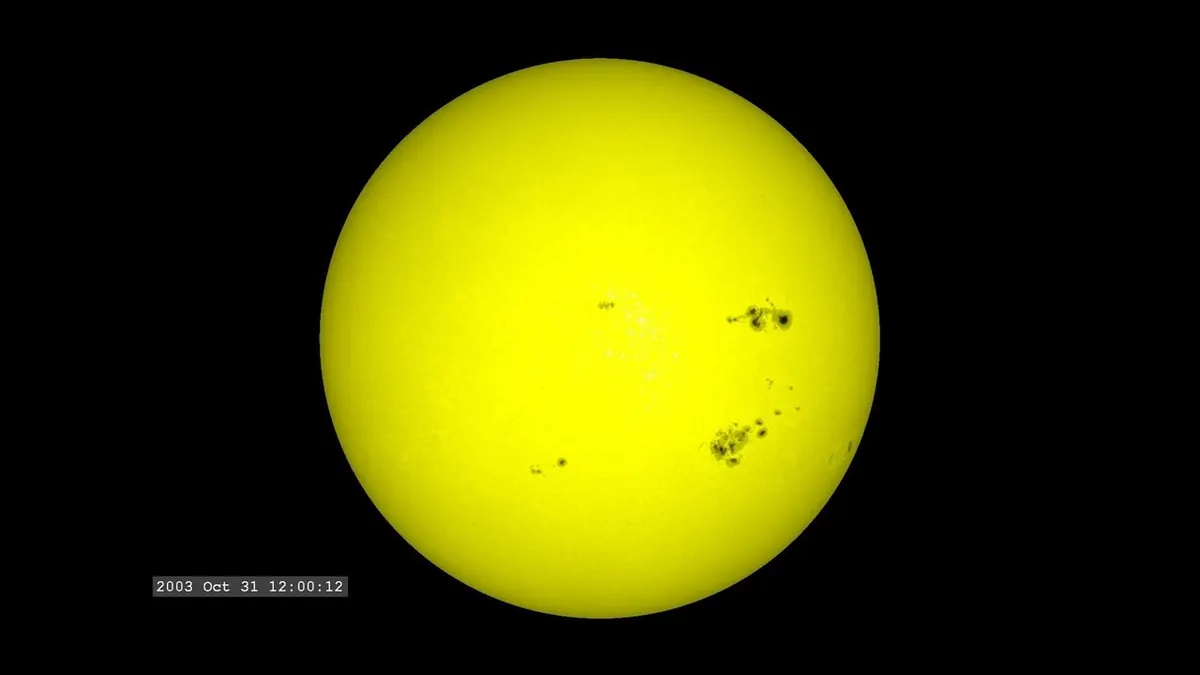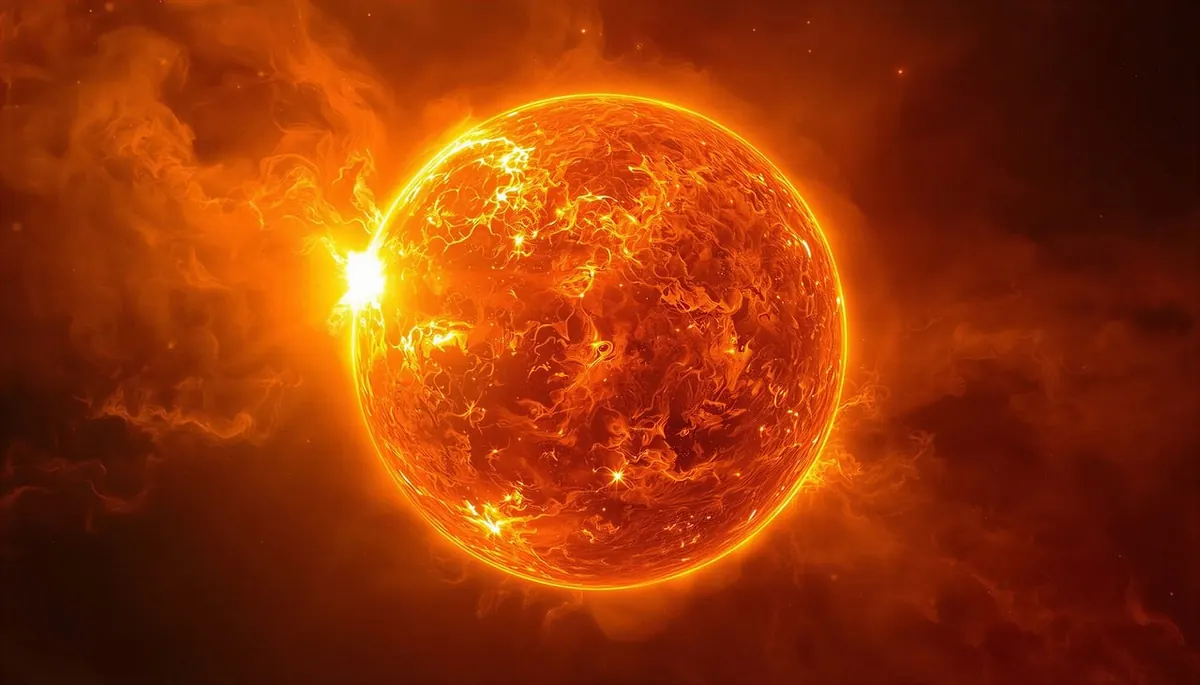
On a quiet afternoon, the Sun can throw a billion tonnes of plasma into space. It can also do almost nothing at all. From the headlines, those two days look identical: a flare erupts, a warning goes out, and a few nights later somebody stands in a frosty field in Northumberland watching cloud.
The confusion usually comes from mixing up two separate events. Flares are bursts of radiation. Auroras are the result of charged particles meeting our magnetic field. They often happen around the same time, but neither one guarantees the other. Once you know how flares are ranked, and what each rank actually does to Earth, the forecasts start making sense.
How flares are classified
Solar flares are graded by how bright they are in soft X-rays, in the 1 to 8 ångström band, as measured by satellites watching the Sun around the clock. The letters run A, B, C, M and X. Each step up the scale is ten times more energetic than the one before, so an M-class flare is ten times the strength of a C-class flare, and an X-class flare is ten times stronger than an M.
- A and B-class: background-level activity. Constant, tiny, and rarely worth a mention outside specialist data feeds.
- C-class: small and common, especially near solar maximum. Usually no noticeable effect on Earth, though a long C-class flare can briefly disturb the ionosphere.
- M-class: moderate. Worth watching. Can cause short HF radio fades on the sunlit side and sometimes launches a coronal mass ejection.
- X-class: the big ones. Capable of wide radio blackouts, radiation storms and, if accompanied by an Earth-directed eruption, strong geomagnetic storms.
Reading the number after the letter
The number tells you where within that class the flare sits. An M5 is five times as intense as an M1, and an X2 is twice an X1. The X category is open-ended rather than capped at ten: the largest events on record were strong enough to saturate the sensors measuring them, and had to be estimated later from other data. So a headline quoting an enormous X-class figure is not necessarily a typo.
What reaches Earth, and how fast
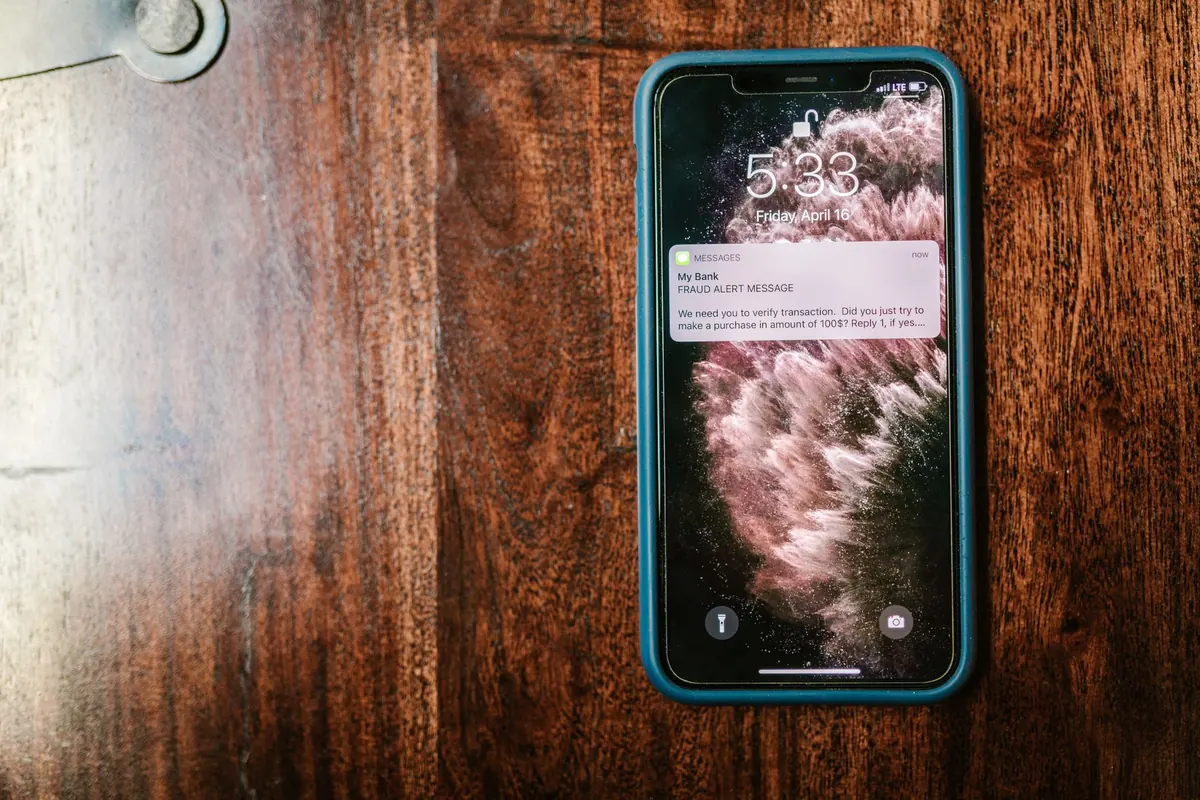
A flare's X-rays and extreme ultraviolet radiation travel at the speed of light. They arrive at Earth roughly eight minutes after leaving the Sun, which is why flare effects are already under way by the time an alert appears on your screen.
That radiation ionises the upper atmosphere, particularly over the daylight side of the planet. At ground level there is nothing to worry about; the atmosphere above you is an effective shield. The consequences are operational and electronic rather than personal. Aviation crews on polar routes can pick up slightly higher radiation doses during a big event, but this is monitored and managed by operators, not something a passenger needs to act on.
Radio blackouts: the flare's immediate calling card
When X-rays strip electrons from atoms in the ionosphere's D layer, that layer starts absorbing high-frequency radio signals rather than letting them pass. The result is a shortwave fade, usually described as a radio blackout. These are graded on a five-point scale:
- R1 (minor): weak fading of low-frequency signals, occasional loss of contact on HF radio.
- R2 (moderate): limited HF blackout on the sunlit side, some degradation of low-frequency navigation.
- R3 (strong): wide HF blackout, navigation signals degraded for roughly an hour.
- R4 (severe): HF blackout across much of the sunlit side, navigation outages for one to two hours.
- R5 (extreme): HF radio blackout over most of the daylight hemisphere for several hours.
The key detail is "sunlit side". Blackouts follow the daylight around the planet, drifting westwards as Earth rotates, and they fade within minutes to a couple of hours as the flare's radiation dies down. Amateur radio operators often notice them first: a band that was working well suddenly goes quiet, then recovers.
Why a huge flare can leave the sky dark
This is the part that catches people out. Auroras need a coronal mass ejection, a cloud of plasma and magnetic field, to reach Earth. Flares and CMEs are related, but they are not the same event, and they do not always travel together.
A flare can be "confined": all that energy released in the corona without any material escaping the Sun. An X-class flare on those terms produces a dramatic radio blackout and precisely no aurora. Even when a CME does launch, several things must line up before you see anything:
- It has to be aimed at us. Eruptions near the Sun's limb often miss Earth entirely.
- It has to be fast and dense enough to disturb the magnetosphere rather than sliding past it.
- Its magnetic field needs to point southward. A sustained negative Bz value lets solar plasma couple efficiently with Earth's field. A strongly northward field often means a damp squib.
- It has to arrive in darkness, with clear skies over a location where the auroral oval reaches.
Travel time matters too. A CME typically takes somewhere between about fifteen hours and three days to cover the distance, so the aurora linked to a flare you read about on Tuesday may not appear until Thursday. And plenty of auroras arrive with no flare at all, driven instead by fast solar wind streaming from coronal holes. Chasing the aurora means watching the solar wind, not just the flare count.
A practical way to follow all of this
If you want to know whether tonight is worth putting a coat on, work through it in order. Start with the flare class and check whether a CME was actually confirmed, because the two are reported separately. Look for a predicted arrival window rather than a single time. Then watch the real-time solar wind measured by spacecraft upstream of Earth: a rising speed, a jump in density and a negative Bz are the combination that gets things going. Check the Kp forecast for your latitude, and then check the cloud.
For radio users, the advice is simpler: when a blackout hits, don't fight it. Drop to lower frequencies, wait, and expect the bands to come back within the hour. For skywatchers, the practical basics still matter more than any forecast. Find a dark spot with a clear northern horizon, give your eyes twenty minutes to adapt, and leave the phone screen alone. A modern phone in night mode can capture a faint aurora your eyes will barely register.
One safety note worth repeating whenever the Sun is in the news: never look directly at the Sun without a proper solar filter. Flares are fascinating from a distance, and the safest way to enjoy one is on a screen, not through an unfiltered lens.
Keeping expectations realistic
Flare classes describe radiation, not auroras. An X-class flare with no Earth-directed CME is a spectacular thing that most people will never notice, while a modest M-class flare followed by a well-aimed eruption can light up the sky over Scotland. Learn the difference between the two, keep an eye on the solar wind as well as the flare count, and you will stop being disappointed by the quiet nights and start recognising the promising ones.
Photo: CreativesMart / Pixabay