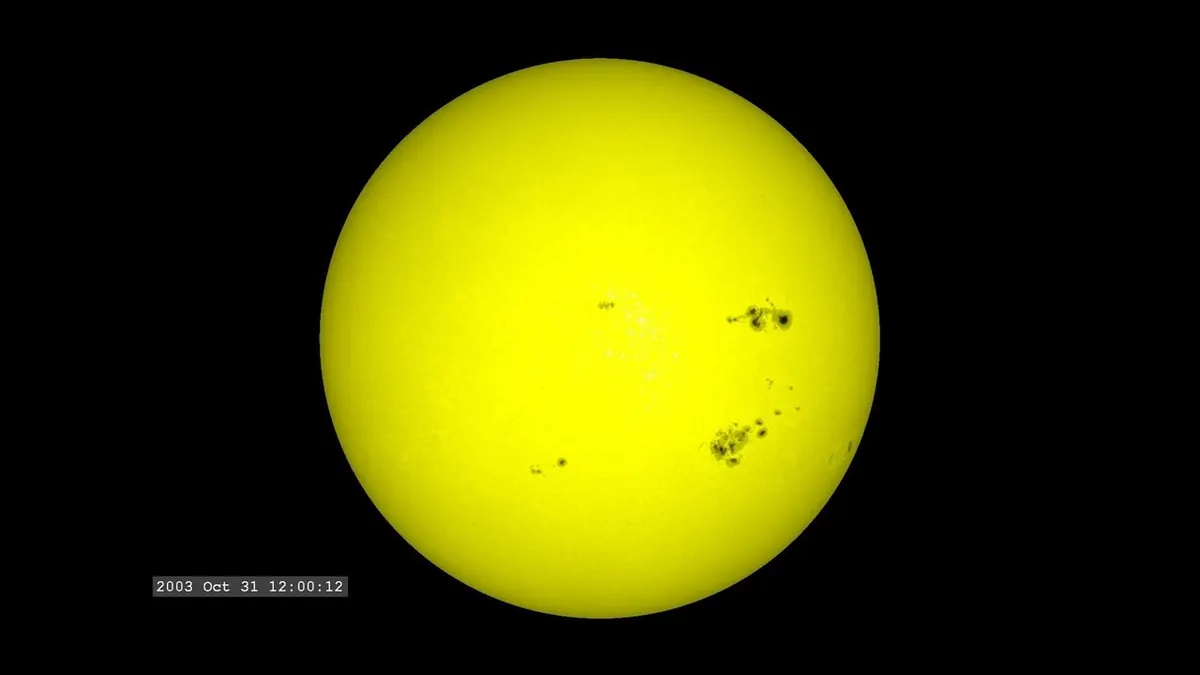
A big sunspot group rotates into view, the words "X-class" start trending, and half of Scotland begins checking the cloud forecast. Then nothing happens. A week later there is no flare worth mentioning and the sky over Northumberland turns green. Flares and coronal mass ejections get blamed for each other constantly, and the confusion costs people clear nights and wasted journeys. They are different events, with different physics, different travel times and very different odds of giving you an aurora.
Solar Flares: A Sudden Flash of Radiation
A solar flare is a rapid release of energy in the Sun's atmosphere, driven by magnetic reconnection — tangled field lines around a sunspot group snapping into a simpler arrangement. The energy escapes mainly as radiation: X-rays, extreme ultraviolet, radio waves, and sometimes visible light. It travels at the speed of light, so by the time a flare shows up in a solar image, its radiation has already arrived.
Flares are graded by X-ray brightness: A, B, C, M and X, each class ten times stronger than the one below, with a number giving finer detail. An M1 is a moderate event; an X10 is a serious one.
The effects land on the daylit side of the planet, within about eight minutes:
- High-frequency radio blackouts, which matter for aviation, maritime and amateur radio
- Temporary degradation of GPS and other satellite navigation signals
- Small anomalies on satellites and extra drag in the upper atmosphere
- Occasionally a solar radiation storm, when energetic protons are accelerated — a concern for satellites and polar flight routes
None of that is plasma. A flare is a flash of light, not a gust of matter, and it is over in minutes to an hour.
CMEs: A Cloud of Magnetised Plasma on the Move
A coronal mass ejection is a genuine ejection: a large mass of plasma, with the solar magnetic field frozen into it, thrown out from the corona. CMEs often launch from an erupting filament and are frequently accompanied by a flare — but the two are separate events. Some powerful flares produce no CME at all. Some CMEs erupt with barely a flicker in X-rays.
Their speeds vary enormously. Slow ones crawl out at a few hundred kilometres per second; the fastest race away at a few thousand. Earth-directed CMEs commonly arrive somewhere between 15 hours and three days after launch, with one to two days a fair bet for a well-aimed, reasonably fast one.
When a CME reaches us it can compress the magnetosphere, dump energy into it, and drive a geomagnetic storm. That is the process behind auroras, satellite charging, increased orbital drag and, in strong storms, induced currents in power grids and pipelines.
Side by Side: What Reaches Earth, and When
- What it is. Flare: a burst of radiation. CME: a cloud of plasma and magnetic field.
- Speed and travel time. Flare: light speed, about eight minutes. CME: hundreds to a few thousand km/s, typically 15 hours to three days.
- Duration at Earth. Flare: minutes. CME: several hours to two days of disturbed conditions.
- Main effects. Flare: radio blackouts, navigation and satellite interference, mostly on the sunlit side. CME: geomagnetic storm, auroras, drag, induced currents.
- Aurora potential. Flare alone: effectively none. CME: high, if the magnetic field it carries points the right way.
- Warning time. Flare: none — it arrives with the light. CME: days of forecast modelling, plus 15–60 minutes of hard data from solar wind monitors at the L1 point.
Why a Flare Alone Cannot Make an Aurora
Auroras are made by particles, not photons. Electrons and ions funnelled down magnetic field lines collide with oxygen and nitrogen in the upper atmosphere, and those atoms emit light — the familiar green from oxygen at around 100 to 150 km, red from oxygen higher up, and purple fringes from nitrogen.
A flare does not deliver those particles. It brightens and disturbs the ionosphere, which is why radio paths fade, but nothing arrives that can be funnelled down the field lines. A flare can produce a brief magnetic "crochet" on ground magnetometers — a small, sharp wobble — and in rare cases a radiation storm. That is not a geomagnetic storm, and it will not hang a curtain of light over your head.
The energy that does light up the sky comes from the solar wind: a CME's plasma cloud, or a fast stream from a coronal hole catching up with slower wind ahead of it.
The one detail that decides everything: Bz
When a CME arrives, its magnetic field has a north-south component called Bz. If Bz points south, it connects well with Earth's northward-pointing field at the magnetopause, opening the door and letting energy pour in. If Bz points north, even a fast, dense CME can largely slide past with surprisingly little effect. This is why two apparently similar storms can look completely different in the sky, and why experienced aurora wat
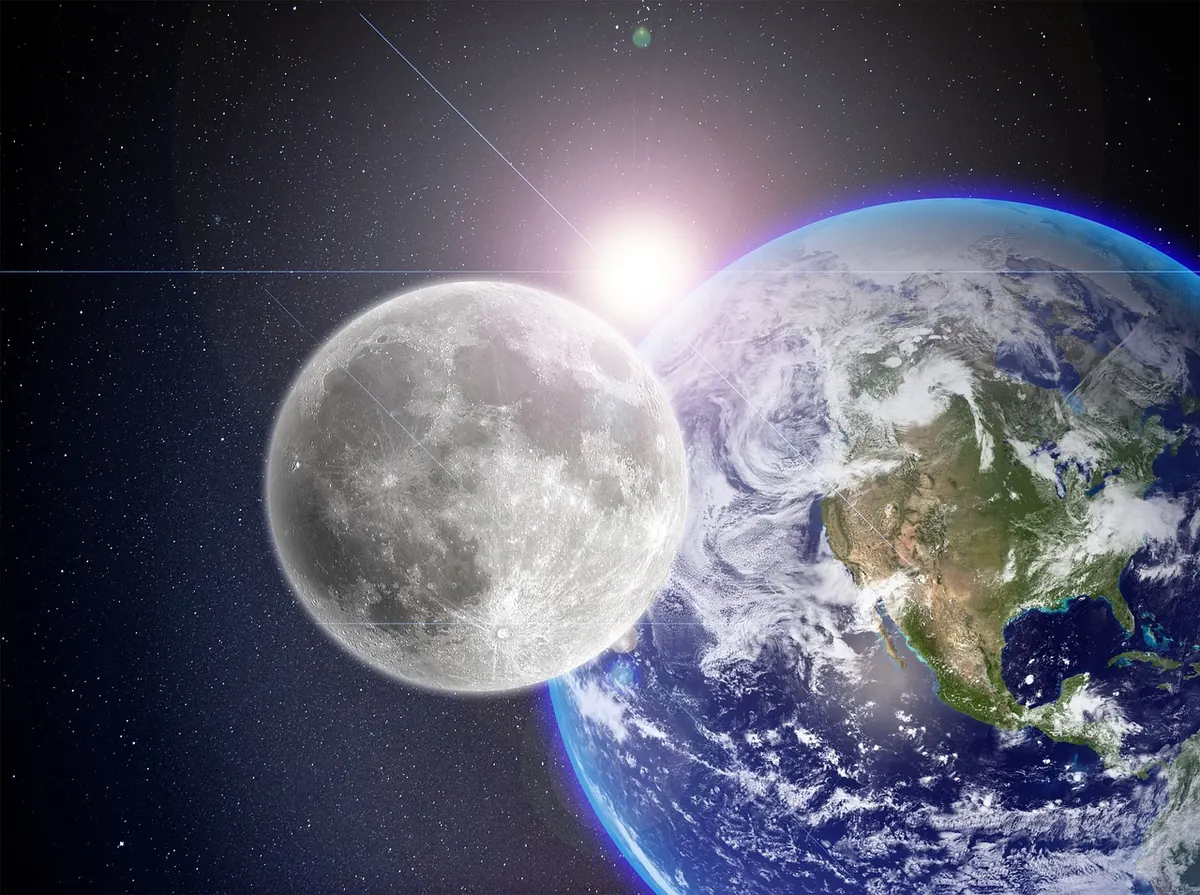
Photo: GuillaumePreat / Pixabay